













Lesser Snow Geese

Lesser Snow Goose Facts:
Weight: 2.5 to 2.7 kg
Wingspan: 38- 46 cm
Lifespan: 10 to 20 years in the wild.
Distinguishing marks: White bodies, black wing-tips, a pink bill with black markings and pink feet.
Best times to view them at the Sanctuary: mid-Oct. to mid-Dec. and mid-March to mid-April.
January 2021 Mid-winter count (Fraser River and Skagit River flocks)=135,000 birds.
The Lesser Snow Geese visiting the Sanctuary are part of the Pacific Flyway nesting population from Wrangel Island, Russia. Lesser Snow Geese generally mate for life, and the three or four young raised each year migrate with their parents. During the summer, when adult geese and the new young birds are all flightless, scientists from Canada, the United States and Russia all work together to capture some of these birds and mark them so that their migratory paths can be better understood. Visitors can help the ongoing international research projects by reporting any marked birds, as over 2,000 birds have been individually marked with coloured neck collars or tracked after the installation of radio-transmittors as part of migration and population studies.
Our Snow Geese start arriving at the Sanctuary by early October and are referred to as the "Fraser-Skagit" flock or subpopulation, as they move back and forth between the estuaries of the Fraser and Skagit Rivers. Arriving from the north, most flocks feed intensively in the Fraser estuary, but some go directly to the Skagit. The Skagit River estuary is just south of the Canada/United States border in the State of Washington, and it provides the birds with flat farmland and coastal marshes similar to those of the Fraser River estuary. From late December to February nearly all of the birds have moved to the Skagit estuary, then return to the Fraser estuary in spring, departing in April for Wrangel Island. Nesting pairs are on their nests and incubating eggs most of June, and the resulting young are ready to fly by late August.
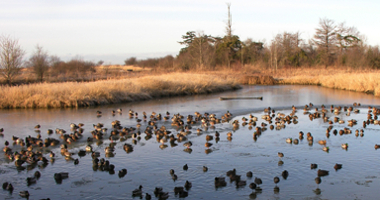
The snow geese provide spectacular wildlife viewing for our visitors. They travel together in very large dense flocks and are restless and constantly moving when Bald Eagles, people and dogs are nearby. Within the flocks, visitors can often identify family groups. The young born that year are fully grown before they migrate to this area, but their first set of adult feathers is grey, not white. Small groups containing two white birds and several darker birds are likely family groups. The snow geese regularly sleep on the water in large dense flocks, sometimes out in the marshes of the estuary, and sometimes in the quiet river channels around the Sanctuary.
Visit our Resources page for a poster about this species.

 These birds fly 5,000 km between Wrangel Island and the Sanctuary. Their migration stops between nesting and wintering grounds include the Russian mainland, St.Lawrence Island (Bering Sea), the Yukon-Kuskokwin delta (western Alaska), Cooke Inlet (southern Alaska), and the mouth of the Stikine River in northern BC. Some marked individuals have made non-stop flights between Alaska and the Sanctuary (2500 km) in less than 36 hours.
  During their stay here, favourite natural foods for these birds are the intertidal marsh plants of the estuary. Marsh plants such as bulrush store starch reserves in their roots and rhizomes. The geese dig up these food sources using their strong bills. The soils in the Delta area are rich in iron compounds, and stain the heads of the geese orange when they have been digging in the marsh. In the spring, the green growth of pastures and marsh plants such as sedges are popular foods.