



|
The
largest wintering concentrations of waterbirds and raptors
in Canada
The
climate is mild, and there are plentiful foods ranging from marine
fish and invertebrates to grasses, rodents and amphibians. Millions
of waterfowl and shorebirds, and over 20 species of birds of
prey consequently all congregate at the mouth of this river,
providing a wonderful wildlife viewing spectacle for the millions
of people in the Vancouver area.
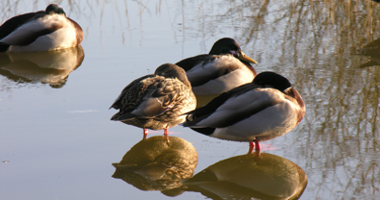
Green-winged
Teal, American Wigeon, Gadwall, Northern Shoveler, Northern Pintail,
Lesser Snow Geese, Trumpeter Swans are the most commonly-observed
waterfowl species seen inshore.
In
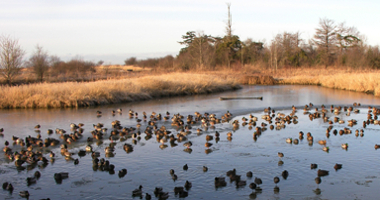
deeper waters, large rafts of diving ducks such as Greater and
Lesser Scaup and Surf Scoters congregate, along with Double-Crested
Cormorants, Western Grebes and many species of gulls. Dunlin
and Western Sandpipers feed in flocks of thousands on intertidal
mudflats, marshes and lowland habitats inland of the dykes.
Bald
Eagles, Northern Harriers, Red-tailed Hawks, Peregrine Falcons
and Short-Eared Owls are just some of the birds of prey to be
seen in the river delta. For some species such as the Barn Owl,
the delta represents the only site in Canada with mild enough
winters for the species to remain year-round.
The
largest salmon-producing river along the Pacific Coast
The
Fraser River is the largest producer of salmon on the entire
Pacific Coast of North America. Annually, millions of anadromous
(migratory) adult salmon migrate upstream to spawn along small
streams along its length and up into the connected waterways
of the Pitt, Lilloet, Chilliwack, Nechako, Chilkotin, Thompson,
Stuart, Adams, and Quesnel Rivers. Millions of young fish hatching
in these areas spend their early life cycle in these upper
reaches, and eventually descend to the estuary on their way out
to oceanic habitats.
Estuarine
marshes, mudflats, floodplains, sloughs and river channels are
all critical feeding and rearing areas for these and other fish
during their transition between river and marine stages of their
life cycle. Pacific Herring, Sturgeon, Eulachon, and Smelt are
also abundant fisheries locally, as are Dungeness crab, Shrimp
and other invertebrates.
World
Recognition as Shorebird Habitat
The
Fraser delta is internationally significant to shorebird populations,
and has been proposed as a WSHRN site.
The abbreviation WSHRN stands for the Western Hemispheric Shorebird Reserve Network,
an international initiative to identify and protect habitats
in key stopover points used by shorebirds during their long migrations
across North and South America (the Western Hemisphere).
The Fraser
delta ranks very highly, as nearly all of the world's population
of western sandpipers stop to rest and refuel during their massive
migrations between Alaska nesting grounds and wintering sites
from California to Peru. In addition, more than 35 other shorebird
species rely on this estuary throughout the year.
The
Pacific Estuary Conservation Program
There
are many agencies collectively striving to preserve habitat along
BC's coast, but the cooperative efforts of specific local conservation
agencies have won national and international awards. One of special
note is the Pacific Estuary Conservation Program (PECP), a partnership
program initiated in 1987 between private conservation groups
such as Ducks Unlimited Canada, the Nature Trust of BC, Wildlife
Habitat Canada, and provincial and federal government environment
and fisheries departments. Through this program, thousands of
hectares of estuary habitat along the BC coast have been set
aside through their collective efforts and funding for either
land acquisition or other conservation designations.
In
1996, the PECP was honoured with a Canadian
Council on Ecological Areas (CCEA) award for its
regional contribution and partnership approach to the establishment
of a Canada-wide network of protected areas. In 1999, the program
was also chosen as a first recipient of the Ramsar Wetland
Conservation Award for its conservation of the long-term sustainable
use of estuarine habitat along the BC coast. |
A
Pacific estuary, one of the richest types of ecosystems in
the world
British
Columbia's estuaries are among the richest in the world. The largest
estuary is formed by the Fraser River and is home to over 400 species
of vertebrates, thousands of plants and a myriad of small invertebrates.
The
Fraser River forms the largest estuary along the Pacific Coast
of North America and drains over 200,000 square kilometers of
BC. River sediments meet the currents of the Strait of Georgia
and are deposited onto the nearly 30,000 hectares of the estuary's
intertidal marshes and mudflats (Sturgeon Banks, Roberts Bank
and Boundary Bay).
A
Critical Crossroads Along the Pacific Flyway
Migration
paths of many migrant birds converge at the Fraser River delta.
Its location mid-way along the Pacific Coast makes it an international
crossroad of bird migration routes from 20 countries and three
continents. Waterfowl and shorebirds from breeding grounds in
Siberia, Alaska, Yukon, and other arctic and prairie areas all
stop to refuel in the Fraser River estuary on their way to wintering
grounds in California, Mexico, Central and South America or the
South Pacific.
Coastal
lowlands and marshes of the estuary provide critical refuelling
opportunities for long-distance migrants such as the Lesser Snow
Goose, which nests in Wrangel Island (Russia) and sometimes makes
non-stop flights of over 2500 km in its southward migration to
wintering grounds.
Global
recognition of the Estuary as a Wetland of International
Significance
The
George C. Reifel Migratory Bird Sanctuary is part of a Ramsar site
(the Alaksen National Wildlife Area), which was endorsed in 1982.
The Ramsar Convention gets its name from the location of the
International Conference on Wetlands held in Ramsar, Iran in
1971.
One
hundred and twelve countries have agreed to a set of criteria
for identifying wetlands of international significance. In terms
of number of waterfowl, British Columbia's Fraser River Delta
exceeds the criteria by more than 30-fold. And its shorebird
populations exceed the criteria 60 times over!
In
recognition of its outstanding international significance, the
Alaksen National Wildlife Area on the Fraser River Delta has
been designated as a "Wetland of International Importance
Especially as Waterfowl Habitat" under the Ramsar Convention,
and is one of two Ramsar sites in British Columbia.
Local
Recognition and Protection of habitats
Local,
regional, provincial, federal and international efforts have
been underway for decades to recognize the environmental value
of the Fraser River estuary. Apart from the RAMSAR and WSHRN
initiatives which provide an international recognition of the
habitats right under our feet, local efforts have also helped
to formally set aside many areas, promote public awareness and
land stewardship. Many have been purchased or established through
land purchases and cabinet designations.
Example
wildlife management holdings include: Alaksen (federal) National
Wildlife Area; and Sturgeon Banks, Boundary Bay and South
Arm Marshes (provincial) Wildlife Managements Areas. Examples
of parks providing wildlife habitat include: Boundary Bay
and Deas Island Regional District Parks and the (municipal) Delta
Nature Reserve. Most larger natural areas of habitat have been
set aside during the past two decades.
Since
the early 1980's, there has been a growing recognition of the
value of coastal lowlands, the role of farmland habitats play
in wildlife management, and the need to support and nurture the
agricultural land base surrounding the estuary marshes. More
information of farm & wildlife issues and related stewardship
initiatives can be obtained from the Delta Farmland Wildlife
Trust. |